


Chewing gum seems harmless.
You chew it after a meal, use it to freshen your breath, or reach for a sugar-free version when you want something sweet without the extra sugar.
But what if one of the ingredients in some popular sugar-free chewing gum products could be linked to heart attack and stroke risk?
That is the question raised by new research involving more than 17,700 people.
The ingredient under scrutiny is xylitol, a sugar alcohol commonly used to sweeten sugar-free chewing gum, toothpaste, candies, drinks and other products. Researchers found that people with higher levels of xylitol circulating in their blood had a greater risk of experiencing major cardiovascular events, including heart attack, stroke or cardiovascular death.
In one group, the risk was 57% higher among people with the highest blood xylitol levels compared with those with the lowest levels.
That sounds alarming.
But before you throw away every packet of chewing gum in your house, there is an important catch: the study does not prove that chewing gum or xylitol causes heart attacks.
So, what did the researchers actually discover?
In This Article:-
The Chewing Gum Ingredient That Has Researchers Paying Attention
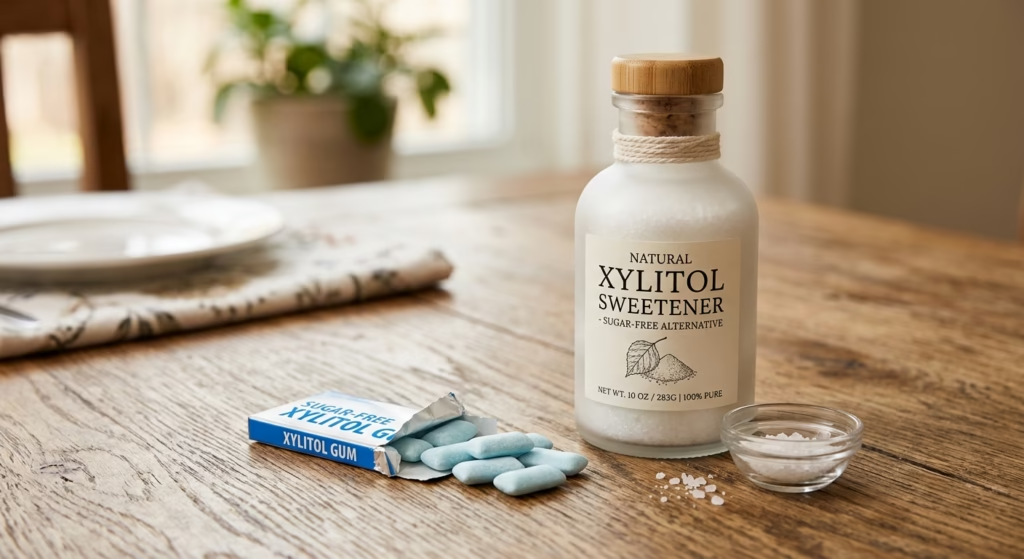
Xylitol is a type of sugar alcohol. It tastes sweet but provides fewer calories than regular sugar and has a much smaller effect on blood glucose.
That is one reason xylitol has become popular in products marketed as sugar-free or tooth-friendly.
You may find xylitol in:
- Sugar-free chewing gum
- Sugar-free candies
- Mints
- Toothpaste
- Oral-care products
- Some processed foods and drinks
For years, xylitol has generally been viewed as a useful alternative to sugar, particularly for dental health.
But cardiovascular researchers have been asking a different question:
Could higher levels of xylitol in the bloodstream affect the way blood clots?
Previous research from Cleveland Clinic investigators suggested that xylitol may increase platelet responsiveness. Platelets are blood components that help stop bleeding by forming clots.
Normally, that process is essential.
But excessive clot formation inside an artery can become dangerous.
If a clot blocks blood flow to the heart, it can cause a heart attack.
If it blocks blood flow to part of the brain, it can cause an ischemic stroke.
This is why the possible connection between xylitol and cardiovascular disease deserves attention.
New Study: 17,710 People Were Put Under the Microscope
The latest research tried to answer a question that earlier studies could not fully address.
Is the association between higher blood xylitol levels and cardiovascular events also seen in people from the general population?
Researchers examined data from two large observational studies:
- The Canadian Longitudinal Study on Aging (CLSA)
- The EPIC-Norfolk study
Together, the studies included 17,710 participants, with an average age of approximately 60.9 years.
The Canadian group was followed for around 6 years, while the European cohort provided data covering approximately 30 years.
Researchers divided participants into groups according to the amount of xylitol detected in their blood plasma.
They also adjusted their analysis for several established cardiovascular risk factors, including:
- Age
- Smoking
- Diabetes
- High blood pressure
- Body mass index
- Other factors associated with cardiovascular disease
The result caught researchers’ attention.
The Risk Was 57% Higher in One Study
During the six-year follow-up of the Canadian Longitudinal Study on Aging, participants with the highest blood xylitol levels had a 57% higher risk of a major adverse cardiovascular event (MACE) compared with those with the lowest levels.
MACE generally refers to serious cardiovascular outcomes such as:
- Heart attack
- Stroke
- Cardiovascular death
The second study, EPIC-Norfolk, followed participants for much longer.
Over approximately 30 years, people with the highest xylitol levels had an 18% higher associated risk of MACE compared with those with the lowest levels.
Researchers also reported a dose-dependent relationship.
In simple terms, as blood xylitol levels increased, the occurrence of major cardiovascular events also tended to increase.
That pattern is one reason scientists believe the finding deserves further investigation.
However, there is a major point that should not be overlooked.
Does Chewing Gum Actually Cause Heart Attacks?
No. The study did not prove that.
This is perhaps the most important message for anyone worried about their chewing gum habit.
The research was observational.
That means researchers looked at existing health data and searched for relationships between xylitol levels and cardiovascular outcomes.
Observational studies can identify important associations, but they cannot establish that one factor directly caused another.
For example, people with higher blood xylitol levels could differ from people with lower levels in ways that researchers have not completely identified.
There is also another complication.
Your blood xylitol level does not necessarily tell researchers exactly how much xylitol you consumed from chewing gum or food.
The human body can produce small amounts of xylitol naturally.
Therefore, a high blood level may reflect more than simply how much sugar-free chewing gum someone chewed.
This makes it too early to say:
“Xylitol-containing chewing gum causes heart attacks.”
The evidence does not support that conclusion yet.
Why Are Scientists Concerned About Blood Clots?
Here is where the research becomes particularly interesting.
Researchers have conducted laboratory and experimental studies examining how xylitol may interact with platelets.
Platelets are crucial for clot formation.
When a blood vessel is damaged, platelets become activated and help create a clot to stop bleeding.
But increased platelet activity can potentially contribute to thrombosis — the formation of a blood clot inside a blood vessel.
If thrombosis occurs in a coronary artery, the consequences can be severe.
The 2024 European Heart Journal study by Witkowski and colleagues reported evidence that xylitol can increase platelet responsiveness and is associated with cardiovascular risk. The research included human platelet experiments, whole-blood studies and animal models in addition to observational human data.
This does not mean every person who chews sugar-free chewing gum will develop a blood clot.
Instead, it provides a possible biological explanation for the association researchers are seeing.
Should You Stop Chewing Gum?
For most people, there is not enough evidence to say that everyone should completely stop chewing gum.
The latest research raises a safety question rather than providing a final answer.
If you occasionally chew a piece of sugar-free chewing gum, there is no evidence from this study showing that you are suddenly at high risk of having a heart attack.
The bigger concern is long-term exposure to high amounts of xylitol and whether certain people may be more vulnerable to its potential effects.
People with existing cardiovascular disease or multiple cardiovascular risk factors may want to discuss frequent use of products containing xylitol with their healthcare professional.
This is especially relevant if sugar-free products make up a large part of the diet.
What About People With Diabetes?
This is where things become more complicated.
Sugar substitutes can have a practical role for people with diabetes because many of them cause a smaller immediate rise in blood glucose than ordinary sugar.
That does not automatically mean that consuming large amounts of sugar substitutes is beneficial for long-term health.
A lower glucose spike is only one part of the picture.
Heart health also depends on:
- Blood pressure control
- Cholesterol levels
- Physical activity
- Body weight
- Smoking status
- Overall diet
- Blood glucose control
- Sleep and stress management
Therefore, replacing sugar with a sugar-free product should not be viewed as a complete health strategy.
Is All Chewing Gum Bad for Your Heart?
Not necessarily.
This is an important distinction.
The research is focused on xylitol levels and cardiovascular outcomes, not on chewing itself.
There are also different types of chewing gum, with different sweeteners and ingredients.
Some chewing gum contains sugar. Others may contain xylitol, sorbitol, erythritol or other sweeteners.
Therefore, it would be incorrect to conclude that the physical act of chewing gum causes heart disease.
The question is more specifically about what is inside the product you are consuming and how frequently you consume it.
If you want to know whether your particular chewing gum contains xylitol, check the ingredient list.
Look for terms such as:
Xylitol — E967
If xylitol is listed near the beginning of the ingredients, the product may contain a meaningful amount.
What Should You Do If You Regularly Use Sugar-Free Chewing Gum?
There is no need to panic.
Instead, take a practical approach.
1. Check the ingredient label
If you regularly use chewing gum, look at the sweetener used in your preferred product.
Do not assume that every sugar-free product is identical.
2. Avoid excessive consumption
More is not necessarily better simply because a product is sugar-free.
If you are chewing gum continuously throughout the day, consider reducing your intake while researchers continue investigating the long-term effects of xylitol.
3. Consider your overall cardiovascular risk
Your risk of heart attack is influenced by many factors.
High blood pressure, diabetes, smoking, high cholesterol, obesity, physical inactivity and family history can all matter.
Managing these established risk factors remains far more important than becoming fixated on one ingredient.
4. Choose whole foods more often
If you want something naturally sweet, whole fruit provides sweetness along with fiber, vitamins and other nutrients.
It is generally better to build your diet around minimally processed foods rather than relying heavily on sweetened or sugar-free products.
5. Talk to your doctor if you have heart disease
If you already have cardiovascular disease or are considered high-risk, discuss your regular use of xylitol-containing products with your doctor.
That is especially sensible if you consume them frequently.
The Bigger Problem: “Sugar-Free” Does Not Always Mean “Risk-Free”
This research highlights a lesson that is easy to miss.
Consumers often assume that if a product contains less sugar, it must automatically be healthier.
But nutrition is rarely that simple.
Removing sugar from a product can change its nutritional profile, but the replacement ingredient also matters.
That does not mean xylitol is proven to be dangerous.
It means scientists are still trying to understand its potential long-term effects at levels commonly encountered in the diet.
The same principle applies to other sugar alcohols and non-nutritive sweeteners.
A product labelled “sugar-free” should not automatically be treated as a health food.
What the Researchers Want to Know Next
The new findings raise several questions.
Does consuming xylitol directly increase cardiovascular risk?
If so, how much is too much?
Does occasional chewing gum use carry the same concern as frequent consumption?
Are people with existing cardiovascular disease more vulnerable?
And could different amounts of xylitol have different effects?
These questions cannot be answered by observational studies alone.
Researchers need more controlled human studies and other well-designed research to determine whether there is a true cause-and-effect relationship.
That distinction matters because an association can sometimes disappear when tested under controlled conditions.
The Bottom Line on Chewing Gum and Heart Health
So, should you panic about chewing gum?
No.
But should you completely ignore the new findings?
Also no.
The latest research found that people with higher blood levels of xylitol had a higher risk of major cardiovascular events.
The strongest signal came from the Canadian cohort, where the highest xylitol group had a 57% higher associated risk over six years. The long-term EPIC-Norfolk data showed an 18% higher associated risk over approximately 30 years.
Laboratory and experimental research also provides a possible mechanism, suggesting that xylitol may increase platelet responsiveness and clotting potential.
But this does not prove that chewing gum containing xylitol causes heart attacks.
For now, the sensible approach is moderation, reading ingredient labels and focusing on the bigger picture of cardiovascular health.
If you enjoy chewing gum occasionally, there is no reason to panic over this study.
But if you are consuming large amounts of xylitol-containing products every day, especially if you already have cardiovascular risk factors, it may be worth discussing your intake with a healthcare professional.
The real takeaway is simple:
“Sugar-free” does not automatically mean “risk-free.”
And when it comes to heart health, what looks like a small ingredient on a label may deserve a much closer look.
Frequently Asked Questions
1. Does chewing gum increase the risk of heart attack?
Current research does not prove that chewing gum itself causes heart attacks. A recent study found an association between higher blood levels of xylitol, a sweetener used in some sugar-free chewing gum, and major cardiovascular events.
2. What is xylitol?
Xylitol is a sugar alcohol used as a sweetener in products such as sugar-free chewing gum, candies, toothpaste and some processed foods. It tastes sweet but generally has fewer calories than sugar.
3. How much higher was the heart risk in the new study?
In the Canadian cohort, people with the highest blood xylitol levels had a 57% higher associated risk of major adverse cardiovascular events than those with the lowest levels over approximately six years. In the EPIC-Norfolk cohort, the associated risk was 18% higher over approximately 30 years.
4. Does this mean I should stop chewing gum?
Not necessarily. The research does not prove that chewing gum causes heart attacks. If you regularly use sugar-free chewing gum, check the ingredients for xylitol and consider moderation while further research is conducted.
5. Is xylitol the same as sugar?
No. Xylitol is a sugar alcohol, not ordinary table sugar. It provides sweetness with fewer calories and generally has less effect on blood glucose than sugar.
6. Can people with diabetes use xylitol?
Xylitol can produce a smaller immediate blood-glucose response than sugar, which can make it useful in some circumstances. However, this does not mean that consuming large quantities is necessarily beneficial for long-term health.
7. Can xylitol cause blood clots?
Laboratory, human platelet and animal research has suggested that xylitol can increase platelet responsiveness and may increase thrombosis potential. However, more research is needed to establish whether normal dietary exposure directly causes cardiovascular events.
8. Is sugar-free chewing gum healthier than regular chewing gum?
It depends on the ingredients and how much you consume. Sugar-free products may reduce exposure to added sugar, but “sugar-free” does not automatically mean that a product is healthy in every respect.
9. What should I look for on a chewing gum label?
If you want to know whether your chewing gum contains xylitol, check the ingredients list for xylitol or E967. Other sugar alcohols may also be used in sugar-free products.
10. Is the new research conclusive?
No. The major 2026 study was observational, meaning it identified an association rather than proving causation. Researchers say additional studies, including well-designed prospective and controlled research, are needed.
Sources and Further Reading
Medical News Today — Popular chewing gum sweetener linked to higher heart attack risk, study finds
Medical News Today — Full article
European Heart Journal — Xylitol is prothrombotic and associated with cardiovascular risk
European Heart Journal — Research paper
European Heart Journal — Xylitol: bitter cardiovascular data for a successful sweetener
European Heart Journal — Commentary
PubMed — Xylitol: bitter cardiovascular data for a successful sweetener
PubMed — Research record
European Heart Journal — Xylitol and cardiovascular risks
European Heart Journal — Follow-up discussion
European Society of Cardiology — European Society of Cardiology Congress 2026
European Society of Cardiology
Medical Disclaimer
This article is for general educational and informational purposes only. It does not replace professional medical advice, diagnosis or treatment. The research discussed above does not establish that chewing gum or xylitol causes heart attacks or strokes. Anyone with cardiovascular disease, diabetes or other significant health conditions should discuss individual dietary concerns with a qualified healthcare professional.
We have a very strict reviewing guidelines on how to run every article in the website. Everything we write follow a very strict reviewing process by following high quality peer-reviewed studies. Every source we follow are credible and accurate and again reviewed by our doctors to give you all high quality advise and content.
For the latest health trending topics and top of the line updated health and fitness related news and conditions with insights from board certified experienced health professionals, follow Healing Doctor on Facebook, Instagram and Whatsapp.