
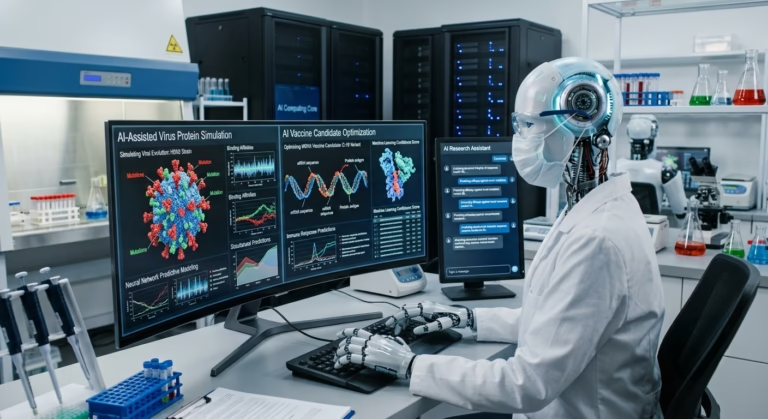

Artificial intelligence has already changed how we search for information, write software, and analyze medical data. Now, researchers are pushing Artificial Intelligence into one of the most complex areas of science: designing biological systems.
In recent studies, scientists demonstrated that AI can help create functional viruses that attack harmful bacteria and develop vaccine components designed to protect against entire families of viruses. These advances could improve treatment for antibiotic-resistant infections and strengthen global preparedness for future pandemics.
At the same time, experts are urging governments and research institutions to strengthen biosafety measures, warning that the same technology capable of saving lives could also be misused if not carefully regulated.
The emergence of AI-assisted biology marks a major shift in biomedical research—one that brings remarkable opportunities alongside important ethical and security challenges.
In This Article :-
Why Scientists Are Turning to AI for Biology
Designing biological molecules or genomes has traditionally required years of laboratory experiments and repeated trial and error. Artificial intelligence changes this process by rapidly analyzing massive genetic datasets and identifying patterns that humans alone would struggle to detect.
Instead of replacing scientists, Artificial intelligence acts as a research assistant that can generate promising biological designs in hours rather than months. Researchers then test these computer-generated designs in controlled laboratory environments.
This approach has already accelerated drug discovery, protein engineering, and antibiotic research. Recent work suggests AI may also assist in designing biological tools that were previously considered too complex for computers to create.
AI Designed Functional Viruses That Target Harmful Bacteria
One of the most discussed breakthroughs came from researchers at Stanford University, who used AI models trained on extensive genetic data to design new bacteriophages, commonly called phages.
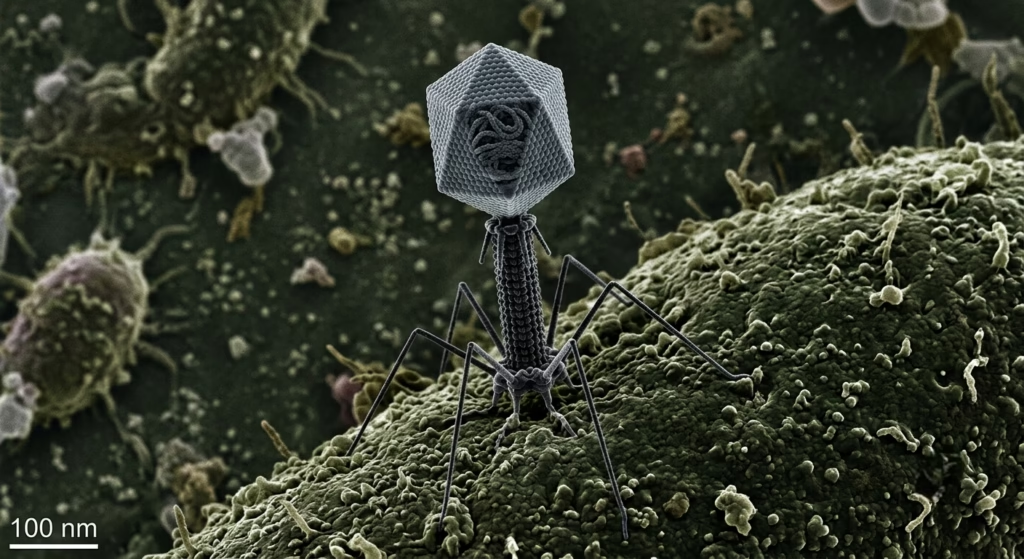
Phages are viruses that infect bacteria rather than humans or animals. Because they specifically attack bacterial cells, scientists have studied them for decades as a possible treatment for infections that no longer respond to antibiotics.
After generating hundreds of AI-created phage genome designs, researchers synthesized selected candidates in the laboratory. Multiple newly designed phages successfully infected and destroyed Escherichia coli (E. coli), demonstrating that AI-generated genome designs could function in real biological systems under controlled laboratory conditions.
Although these laboratory-designed viruses are capable of replication, they were specifically engineered to infect bacteria—not people.
Why This Discovery Matters
Antibiotic resistance has become one of the world’s fastest-growing public health challenges.
According to the World Health Organization (WHO), antimicrobial resistance contributes to millions of deaths globally each year and threatens the effectiveness of many life-saving medicines.
Phage therapy offers one possible alternative because bacteriophages naturally destroy bacteria while leaving human cells unaffected.
If AI can accelerate the design of customized bacteriophages, doctors may eventually have faster options for treating difficult bacterial infections that fail to respond to conventional antibiotics.
Researchers believe Artificial Intelligence could dramatically reduce the time required to identify effective phages for specific bacterial strains, potentially making personalized infection treatment more practical in the future.
A New Chapter in Synthetic Biology
The significance of this research extends beyond bacteriophages.
Scientists view it as an important milestone in synthetic biology, a field focused on designing or modifying biological systems to solve medical, agricultural, and environmental problems.
Rather than relying only on naturally occurring organisms, researchers can increasingly use AI to suggest new genetic designs based on patterns learned from millions of DNA sequences.
This does not mean AI is creating entirely new forms of life independently. Every AI-generated design must still undergo rigorous laboratory validation before scientists can determine whether it works safely and as intended.
Nevertheless, the ability to generate complete genome designs using Artificial Intelligence represents a significant advance in computational biology and may influence future research in medicine, biotechnology, and drug development.
AI-Designed Vaccines Could Transform Pandemic Preparedness
While one research team explored how artificial intelligence can design bacteriophages to fight antibiotic-resistant bacteria, another group focused on a different challenge: preventing future pandemics before they begin.
Researchers at the University of Cambridge have developed what they describe as one of the first vaccines whose key antigen—the part of a vaccine that trains the immune system—was designed entirely using artificial intelligence before entering early-stage human testing.
Instead of targeting only one known virus, the goal is much broader: creating vaccines capable of protecting against an entire family of viruses, including strains that have not yet emerged.
Why Current Vaccines Often Need Updates
Viruses constantly change through mutations. These genetic changes can alter the proteins on their surface, making it harder for the immune system to recognize them after previous vaccination or infection.
This is why seasonal influenza vaccines are updated regularly and why several COVID-19 vaccines have required reformulation to match newly circulating variants.
Traditional vaccine development often follows a reactive approach—scientists identify a new strain, study it, and then develop an updated vaccine. While effective, this process takes valuable time during rapidly spreading outbreaks.
Researchers believe Artificial Intelligence could help shift this strategy from reacting to predicting.
How Artificial Intelligence Designed the Vaccine
To create the experimental vaccine, researchers collected genetic information from numerous known coronaviruses identified through global disease surveillance programs.
Artificial intelligence analyzed these viral genomes and searched for common biological features shared across different coronavirus species.
Using these patterns, the AI designed a “super-antigen”—a vaccine component intended to teach the immune system to recognize regions that remain relatively stable even as viruses evolve.
The objective is straightforward: rather than preparing the immune system for one specific coronavirus, train it to recognize multiple related viruses, including those that may emerge in the future.
If successful, this strategy could reduce the need to redesign vaccines every time a virus mutates.
Early Human Trials Show Encouraging Results
The AI-designed vaccine has already entered early human testing.
The initial clinical trial involved 39 healthy volunteers, with the primary objective of evaluating safety rather than measuring long-term protection.
According to the published findings, the vaccine demonstrated an acceptable safety profile and generated measurable immune responses. Researchers described the immune response as modest, which is common during early-stage vaccine development when scientists are still optimizing vaccine design and dosage.
A larger follow-up study involving approximately 200 participants is expected to provide clearer information about how effectively the vaccine stimulates the human immune system.
While additional research is needed before the vaccine could become widely available, these early findings suggest that AI-designed vaccine components can move successfully from computer models into human clinical research.
Preparing for the Next Pandemic Before It Starts
One of the biggest lessons from the COVID-19 pandemic was that rapid vaccine development can save lives—but preparing before an outbreak begins may be even more effective.
Scientists hope Artificial Intelligence will allow them to identify shared characteristics among viruses with pandemic potential and design vaccines before those viruses spread widely in humans.
Researchers are already applying this approach to several high-priority infectious diseases, including:
- Seasonal influenza
- H5N1 avian influenza (bird flu)
- Ebola and other viral hemorrhagic fevers
- Emerging zoonotic viruses that could spread from animals to humans
If successful, these next-generation vaccines could provide broader and longer-lasting protection than many current vaccines.
Artificial Intelligence Is Accelerating Biomedical Research
Artificial intelligence is influencing far more than vaccine design.
Researchers are increasingly using Artificial Intelligence to:
- Identify new drug candidates.
- Predict protein structures and biological interactions.
- Design enzymes for rare genetic disorders.
- Improve antibody development for cancer immunotherapy.
- Analyze genetic mutations linked to inherited diseases.
- Accelerate precision medicine by matching treatments to individual patients.
Tasks that once required years of laboratory investigation can now begin with AI-generated predictions, allowing researchers to focus their experiments on the most promising candidates.
Although laboratory validation remains essential, Artificial Intelligence is helping scientists reduce development time, lower research costs, and explore biological questions at a scale that was previously impossible.
A New Era of Medical Innovation
The combination of artificial intelligence and biotechnology is changing how scientists approach some of the world’s most challenging health problems.
From designing bacteriophages that may combat antibiotic-resistant bacteria to creating vaccine candidates intended to protect against future pandemics, Artificial Intelligence is becoming an increasingly valuable research tool.
These developments are still in the experimental stage, and many will require years of additional research before becoming part of routine clinical care. However, they demonstrate that AI has the potential to support faster, more targeted, and more adaptable medical innovation than ever before.
The Other Side of Artificial Intelligence: Why Biosafety Matters More Than Ever
While these scientific breakthroughs have generated excitement across the medical community, they have also sparked an important global conversation about safety.
Artificial intelligence is becoming increasingly capable of designing biological sequences, raising questions about how such technology should be governed. Many biosecurity experts believe that as Artificial Intelligence continues to evolve, strong oversight will be just as important as scientific innovation.
The concern is not about the current research itself but about how similar technologies could be used in the future if they fall into the wrong hands or are applied without appropriate safeguards.

Why Scientists Are Calling for Stronger Biosafety Measures
Experts from leading research institutions have emphasized that AI-assisted genome design should be developed responsibly.
One of the primary concerns is that powerful AI systems capable of generating genetic sequences could theoretically be misused to create harmful biological agents. Although today’s research focuses on beneficial medical applications, scientists agree that clear regulations and international cooperation are essential to prevent misuse.
For this reason, many researchers advocate for strict biosafety protocols, transparent research practices, and careful evaluation before advanced AI-designed biological systems are developed further.
The discussion is no longer about whether Artificial Intelligence will influence biotechnology—it is about ensuring that innovation progresses safely and responsibly.
How Researchers Reduced Risk During Their Studies
The research teams behind these breakthroughs implemented multiple safety measures throughout their work.
In the virus-design study, scientists deliberately trained their Artificial Intelligence models using genetic information that excluded viruses capable of infecting humans or other complex organisms. Instead, they focused on bacteriophages, viruses that naturally infect bacteria and have long been studied as potential treatments for antibiotic-resistant infections.
All laboratory experiments were performed in secure research facilities under controlled conditions, and only a carefully selected number of AI-generated designs were synthesized and tested.
Similarly, the AI-designed vaccine research followed the standard regulatory pathway for vaccine development. Human studies began with small clinical trials designed primarily to evaluate safety before progressing to larger studies that will assess immune protection more thoroughly.
These precautions demonstrate that while AI is accelerating scientific discovery, laboratory validation and regulatory oversight remain essential at every stage.
What Could Artificial Intelligence Mean for the Future of Medicine?
Artificial intelligence is already transforming several areas of healthcare beyond vaccine research.
Scientists are using Artificial Intelligence to identify potential drug candidates, design proteins with specific medical functions, analyze complex genetic diseases, and accelerate the development of targeted therapies.
Some of the most promising future applications include:
- Personalized bacteriophage therapies for antibiotic-resistant infections.
- Universal vaccines that provide protection against multiple virus variants.
- AI-designed antibodies for cancer immunotherapy.
- Enzyme therapies for inherited genetic disorders.
- Faster identification of treatments during future infectious disease outbreaks.
Although many of these technologies are still under development, they highlight how Artificial Intelligence could significantly reduce the time needed to move from scientific discovery to clinical testing.
Experts Believe Artificial Intelligence Could Reshape Biomedical Research
Researchers involved in both studies believe these advances represent more than isolated scientific achievements.
Instead, they demonstrate that artificial intelligence is beginning to understand complex biological patterns that previously required years of experimental research.
Experts suggest that Artificial Intelligence may eventually help scientists design new medicines, improve precision therapies, predict emerging infectious diseases, and develop vaccines before outbreaks become widespread.
However, they also emphasize that Artificial Intelligence should be viewed as a powerful research tool—not a replacement for laboratory science. Every AI-generated design must still undergo extensive laboratory testing, safety evaluation, and regulatory review before it can become part of routine medical practice.
Final Thoughts
Artificial intelligence is entering a new phase in biomedical research.
Within just a few years, Artificial Intelligence has evolved from helping scientists analyze medical data to assisting in the design of functional bacteriophages and next-generation vaccine components. These achievements demonstrate the growing potential of AI to solve some of healthcare’s most pressing challenges, including antibiotic resistance and future pandemic preparedness.
At the same time, these breakthroughs remind us that scientific progress must be accompanied by responsible governance, ethical decision-making, and strong biosafety standards.
The future of Artificial Intelligence in medicine will not be determined solely by how advanced the technology becomes, but by how responsibly researchers, governments, and healthcare organizations choose to develop and regulate it.
If used wisely, artificial intelligence could help usher in a new era of safer, faster, and more personalized medical innovation that benefits millions of people worldwide.
Frequently Asked Questions (FAQs)
1. Did researchers create viruses that can infect humans?
No. The AI-designed viruses developed in the Stanford study were bacteriophages, which infect bacteria rather than humans. The research was conducted under strict laboratory conditions.
2. What is a bacteriophage?
A bacteriophage, often called a phage, is a virus that naturally infects bacteria. Scientists are investigating phage therapy as a possible solution for treating antibiotic-resistant bacterial infections.
3. What makes the AI-designed vaccine different from traditional vaccines?
Traditional vaccines are typically developed against known virus strains. The AI-designed vaccine aims to train the immune system to recognize shared features across multiple coronaviruses, potentially providing broader protection against future variants.
4. Has the AI-designed vaccine been tested in humans?
Yes. Early-stage clinical trials involving 39 volunteers have assessed the vaccine’s safety, while larger studies are underway to evaluate its effectiveness in stimulating protective immune responses.
5. Why are scientists concerned about Artificial Intelligence in biotechnology?
While AI has enormous potential to improve medicine, experts believe strong biosafety and biosecurity measures are essential to ensure that advanced biological design technologies are used responsibly and are not misused.
Sources:-
- Stanford University & Arc Institute – Generative Design of Novel Bacteriophages with Genome Language Models
- University of Cambridge – New Universal Vaccine Technology Could Protect Us from Future Virus Outbreaks
- Journal of Infection – A Phase I Clinical Trial of an AI-Designed Pan-Sarbecovirus Vaccine
- World Health Organization (WHO) – Antimicrobial Resistance
- Stanford Medicine – Center for Phage Pharmaceuticals
- Science (Journal) – AI-Generated Functional Bacteriophage Genome Research
- Johns Hopkins Center for Health Security
We have a very strict reviewing guidelines on how to run every article in the website. Everything we write follow a very strict reviewing process by following high quality peer-reviewed studies. Every source we follow are credible and accurate and again reviewed by our doctors to give you all high quality advise and content.
For the latest health trending topics and top of the line updated health and fitness related news and conditions with insights from board certified experienced health professionals, follow Healing Doctor on Facebook, Instagram and Whatsapp.