

Medically reviewed by Dr Itender Pal Singh
Screen time has become part of childhood.
Children use phones to watch cartoons, tablets to complete homework, televisions for entertainment, computers for school and gaming consoles to play with friends. For many families, completely eliminating screens is neither realistic nor necessary.
But there is a problem.
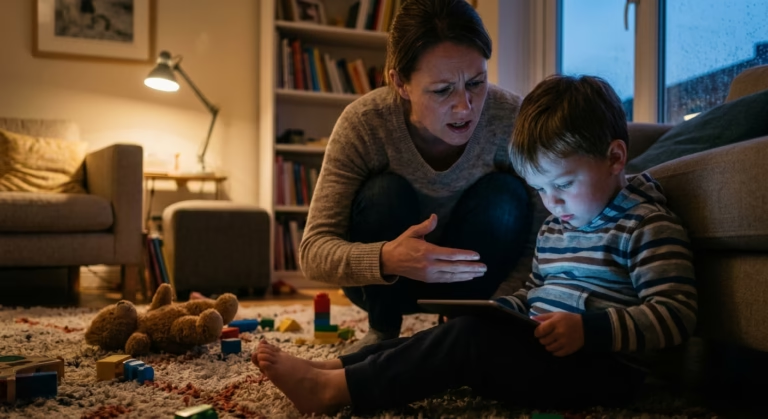
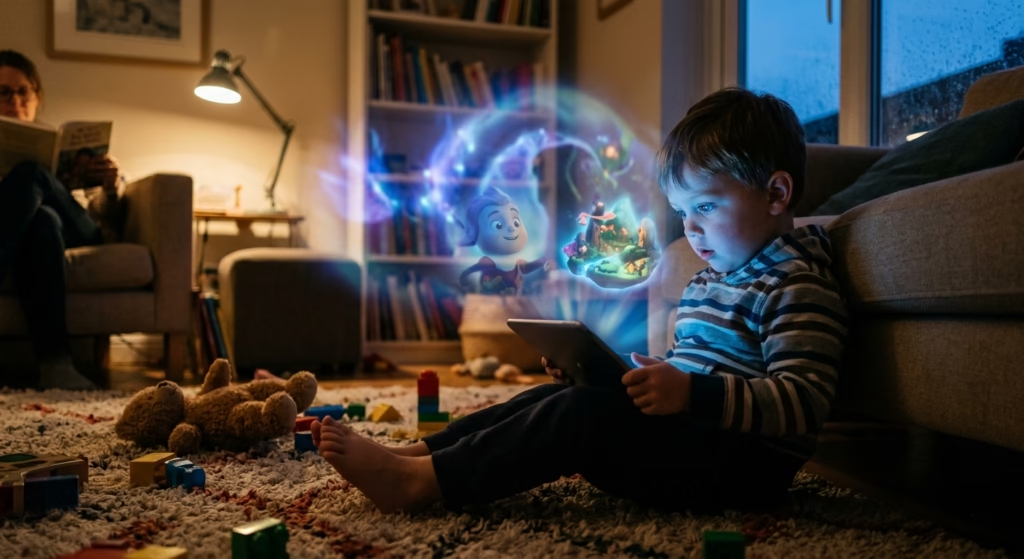
A child may start with 20 minutes of YouTube and somehow end up spending hours watching videos, playing games or scrolling. Bedtime gets pushed later. Outdoor play disappears. Homework takes longer. Family conversations become shorter.
So, how much screen time is too much for children?
The answer is more complicated than simply saying “one or two hours.”
Modern pediatric guidance increasingly emphasizes what children are doing on screens, when they are doing it, what screen use replaces, and whether it interferes with sleep, physical activity, learning, relationships and family life.
Here’s what parents need to know.
In This Article:-
What Is Screen Time?
Screen time refers to time spent using devices with screens, including:
- Smartphones
- Tablets
- Television
- Computers and laptops
- Video-game consoles
- Handheld gaming devices
- Streaming services
- Social media
- Educational apps
- Video calls
Not all screen use is the same.
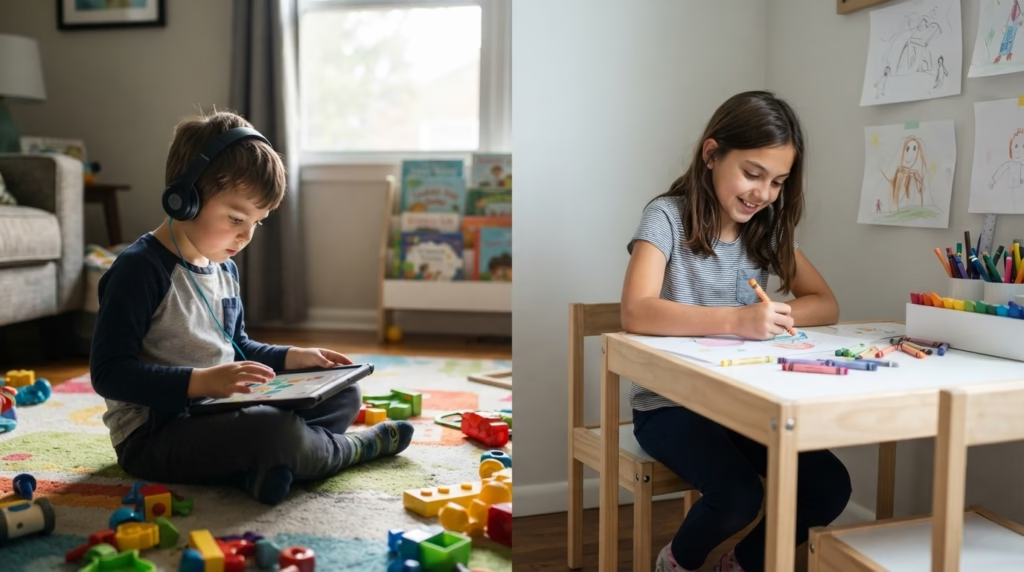
A child video-chatting with a grandparent, completing a school assignment or following an educational lesson is having a very different experience from a child spending hours passively watching short videos.
That distinction matters.
The American Academy of Pediatrics now emphasizes that families should consider the quality and context of media use, rather than relying on one universal number of hours for every child and teenager.
The Real Problem Isn’t Just the Screen
Here’s where many parents get confused.
The question shouldn’t always be:
“How many hours did my child spend on a screen?”
Instead, ask:
“What did that screen time replace?”
If a child spends 45 minutes watching an educational program and still gets adequate sleep, physical activity, homework, family interaction and outdoor play, the situation is very different from a child spending three hours gaming instead of sleeping or exercising.
AAP guidance for school-aged children and adolescents therefore favors an individualized family media plan rather than a rigid one-size-fits-all rule.
Why Too Much Screen Time Can Become a Problem
1. It Can Steal Sleep
This may be one of the most important concerns.
Children who use screens late at night may go to bed later, sleep for fewer hours or experience poorer sleep.
A systematic review of 67 studies involving school-aged children and adolescents found that screen exposure was adversely associated with sleep outcomes in about 90% of the studies reviewed. The researchers noted that screen use was associated particularly with shorter sleep duration and delayed sleep timing.
More recent research continues to raise concerns about smartphone and tablet exposure.
A systematic review and meta-analysis involving children aged 5–10 found that each additional hour of smartphone/tablet use was associated with an average reduction of approximately 11 minutes of sleep. The analysis also found associations with shorter sleep duration and poorer sleep quality.
That creates a familiar cycle:
More screen use → later bedtime → less sleep → tired child → poorer concentration → more difficulty managing emotions.
What parents can do
Make the bedroom a screen-free zone.
AAP guidance recommends avoiding screens for approximately one hour before bedtime and keeping devices out of children’s bedrooms during sleep.
2. Screen Time Can Replace Physical Activity
Children need movement.
Running, cycling, climbing, playing sports, dancing and simply playing outdoors all contribute to healthy development.
The concern isn’t that every minute spent sitting in front of a screen is automatically harmful. The concern is what happens when screen use gradually replaces movement.
WHO recommends that young children have substantial opportunities for physical activity throughout the day. For example, children aged 3–4 years should get at least 180 minutes of physical activity spread across the day, including at least 60 minutes of moderate-to-vigorous activity.
A 2026 systematic review of 29 studies involving more than 83,000 children aged 5–13 years found that only about 10.2% met all three recommended movement-related targets for physical activity, recreational screen use and sleep.
That statistic highlights an important point:
Screen time cannot be considered separately from the rest of a child’s day.
3. Could Screen Time Affect Mental Health?
This is one of the most debated areas of research.
Studies have found associations between higher screen use and various emotional and behavioral difficulties, including anxiety, depressive symptoms, attention problems and social difficulties.
A 2026 systematic review examining 52 studies involving children aged 0–12 years reported positive associations between screen time and several mental-health-related outcomes, including attention problems, mood symptoms, emotional and social difficulties, conduct problems, low self-esteem and sleep disturbances.
But there’s an important caveat.
Association does not automatically mean causation.
For example, a child experiencing anxiety might spend more time online because digital entertainment provides an escape. In that situation, the underlying problem may contribute to increased screen use rather than screen use being the sole cause.
The researchers themselves highlighted limitations involving the lack of longitudinal data and reliance on reported screen exposure.
So parents shouldn’t conclude:
“Screens cause depression.”
The evidence is more nuanced.
A better conclusion is:
Heavy or problematic digital media use may be associated with poorer mental-health outcomes, particularly when it interferes with sleep, relationships, physical activity or daily functioning.
4. Attention and Learning Can Take a Hit
Imagine a child doing homework while:
- YouTube is playing in the background.
- WhatsApp notifications keep appearing.
- A game is open in another tab.
- Short videos are only one swipe away.
The child may technically be “studying,” but their attention is constantly being interrupted.
Entertainment media can also make ordinary activities feel less stimulating by comparison.
This is why parents should distinguish between purposeful digital learning and endless entertainment.
Research suggests that some interactive educational apps can support learning. A systematic review of 35 studies involving children younger than six found evidence of learning benefits from some interactive apps, particularly for early mathematics skills.
So the message isn’t:
“All screens are bad.”
It is:
“Use the right screen, for the right purpose, at the right time.”
5. Screen Time Can Affect Family Relationships
Have you ever tried talking to a child while they are watching a video?
They may hear you.
But they’re not necessarily listening.
The same thing can happen when parents are constantly checking their own phones.
AAP describes this type of interruption of parent-child interaction as “technoference.” Parental digital media use can sometimes compete with verbal and emotional engagement with children.
This creates an uncomfortable truth:
Children learn digital habits partly by watching adults.
If parents demand that children put away their phones while checking their own phones throughout dinner, the rule becomes difficult to enforce.
6. Not All Screen Time Is Equal
Consider these four situations.
Scenario 1: Video call with grandparents
A child talks to a grandparent for 20 minutes.
This can support relationships.
Scenario 2: Educational activity
A child spends 30 minutes completing an age-appropriate maths activity.
This may support learning.
Scenario 3: Watching videos for two hours before bed
This may interfere with sleep and reduce time available for other activities.
Scenario 4: Three hours of gaming instead of outdoor play
The concern isn’t simply the number “three.”
The bigger issue is what has been displaced.
This is why current AAP guidance emphasizes content, context, quality and balance, rather than treating every minute of screen use as equivalent.
How Much Screen Time Should Children Have?
There is no single number that works perfectly for every child.
However, age-specific guidance can provide useful starting points.
Babies Under 18 Months
AAP guidance recommends avoiding screen media other than video chatting for children younger than 18 months.
Babies learn through:
- Talking
- Touching
- Moving
- Looking at faces
- Exploring objects
- Playing
- Responding to caregivers
A screen cannot replace those experiences.
Children 18–24 Months
If parents decide to introduce digital media, AAP recommends choosing high-quality content and watching or using it together with the child rather than allowing independent use.
Children 2–5 Years
AAP guidance recommends limiting screen use to approximately one hour or less per day of high-quality programming, with parents encouraged to watch together and help children understand what they are seeing.
WHO similarly recommends no more than one hour of sedentary screen time for children aged 2 years and for children aged 3–4 years, with less being better.
Children 6 Years and Older
This is where things become less straightforward.
AAP does not recommend a universal number that applies to every child or teenager. Instead, families are encouraged to develop a media plan that protects sleep, physical activity, education, relationships and other important activities.
The New Rule Parents Should Follow: Protect the Essentials First
Instead of asking:
“How many hours of screen time can my child have?”
Start with:
1. Is my child sleeping enough?
2. Is my child physically active every day?
3. Is homework getting completed?
4. Is my child spending time with family and friends?
5. Is my child eating meals without constantly looking at a screen?
6. Can my child stop using the device without a major argument?
7. Is screen use affecting mood, behavior or school performance?
If the answers are concerning, screen use may need to be reduced even if the total number of hours doesn’t look extreme.
10 Practical Ways to Reduce Screen Time Without Constant Arguments
Telling a child:
“Turn it off NOW!”
may work occasionally.
But it isn’t a long-term strategy.
Try these approaches instead.
1. Create Screen-Free Zones
Good places to start include:
- Dining table
- Bedrooms
- Family conversations
- Homework areas
- Car journeys when screens aren’t needed
AAP’s updated digital-media guidance specifically supports screen-free times and places, including mealtimes, bedrooms and the hour before bedtime.
2. Give a Warning Before Turning the Device Off
Instead of suddenly ending a game:
“You have 10 minutes left.”
Then:
“Five minutes.”
This gives the child time to finish.
3. Use a Timer
Let the timer become the “bad guy.”
That can reduce the feeling that the parent is arbitrarily taking something away.
4. Don’t Use Screens as the Default Babysitter
Screens can occasionally be useful when parents need to get something done.
But if a child learns:
bored → screen
sad → screen
angry → screen
waiting → screen
they may have fewer opportunities to develop independent ways of coping with boredom and emotions.
AAP specifically cautions against making digital media the only strategy for calming young children.
5. Replace Screen Time With Something Attractive
Don’t simply remove the tablet.
Offer alternatives:
- Cycling
- Football
- Drawing
- Lego
- Reading
- Cooking
- Gardening
- Board games
- Music
- Outdoor play
- Visiting friends
Children are more likely to accept reduced screen use when something interesting replaces it.
6. Watch Together
Co-viewing gives parents an opportunity to ask:
“Why do you think that happened?”
“What would you do?”
“Is that real or fictional?”
This transforms passive viewing into conversation and learning.
7. Turn Off Autoplay
Autoplay is designed to keep content coming.
Removing it creates a natural stopping point.
8. Keep Devices Out of Bedrooms at Night
Charge phones and tablets in a common area rather than beside the child’s bed.
This removes one of the easiest ways for late-night screen use to continue.
9. Parents Need Screen Rules Too
If adults are constantly on their phones, children notice.
Create family rules that apply to everyone.
10. Review the Rules Regularly
A rule that works for a 7-year-old may not work for a 13-year-old.
AAP’s Family Media Plan is designed to be personalized and revisited as children grow.
What About Gaming?
Gaming isn’t automatically harmful.
Games can provide:
- Problem-solving
- Strategy
- Hand-eye coordination
- Social interaction
- Creativity
- Enjoyment
But problems can arise when gaming becomes difficult to control or starts interfering with:
- Sleep
- School
- Physical activity
- Family life
- Friendships
- Mood
Parents should pay attention to behavior, not just the clock.
A child who plays for an hour and happily stops is very different from a child who becomes extremely distressed every time gaming ends.
What About YouTube and Short Videos?
This deserves special attention.
Short-form videos are designed to deliver another piece of content quickly.
One video becomes another.
Then another.
Then another.
The AAP notes that some modern platforms and games are designed in ways that can make them difficult to put down and can encourage prolonged use.
Parents can reduce this effect by:
- Turning off autoplay
- Using parental controls
- Choosing age-appropriate content
- Avoiding screens during meals
- Establishing specific viewing periods
- Watching selected content rather than endless scrolling
- Keeping phones out of bedrooms
Is Screen Time Bad for Children’s Eyes?
Parents often worry about eye damage from screens.
A more practical concern is digital eye strain.
Children may experience:
- Dry eyes
- Eye fatigue
- Headaches
- Blurred vision
- Difficulty focusing
Long periods of close-up screen use can also mean children spend less time outdoors.
Encourage children to take regular breaks, look away from the screen and spend time outside.
If a child frequently complains of headaches, blurred vision, eye pain or difficulty seeing the board at school, an eye examination is appropriate.
The 20-20-20 Rule
For prolonged near-screen work, a commonly used approach is the 20-20-20 rule:
Every 20 minutes, look at something about 20 feet away for at least 20 seconds.
It is a simple habit that encourages regular visual breaks.
Screen Time and Obesity: What’s the Connection?
The relationship is probably not simply:
screen → obesity.
Instead, several factors may interact.
More recreational screen use can mean:
- Less physical activity
- More sitting
- More snacking
- Exposure to food advertising
- Later bedtime
- Disrupted sleep
AAP’s current approach recognizes that research linking screen exposure and weight varies, which is one reason it moved away from a universal screen-time limit for older children and adolescents.
The goal should therefore be to build a healthy daily routine rather than obsess over one number.
The Biggest Warning Signs Your Child May Be Getting Too Much Screen Time
Watch for changes such as:
- Frequent arguments when screens are removed
- Difficulty stopping independently
- Staying awake late to use a device
- Hiding screen use
- Falling grades
- Reduced interest in outdoor play
- Less face-to-face interaction
- Skipping meals or eating while constantly watching
- Headaches or eye discomfort
- Irritability after prolonged use
- Losing interest in hobbies
- Using screens to escape every uncomfortable emotion
- Screen use interfering with sleep
One sign doesn’t necessarily mean there is a problem.
But several signs occurring together deserve attention.
What Parents Should NOT Do
Avoid turning screen rules into constant punishment.
Don’t use:
“You are addicted to your phone!”
Instead say:
“The phone is making it harder for you to sleep, so we’re changing when you can use it.”
Focus on the behavior rather than labeling the child.
And don’t expect perfection.
There will be long car journeys, sick days, holidays, rainy afternoons and moments when a screen is genuinely useful.
Healthy digital habits are about balance, not guilt.
A Simple Family Screen Time Plan
Try this tonight.
Morning
Keep the first part of the morning screen-free where practical.
Get dressed, eat breakfast and prepare for school before recreational media.
After School
Prioritize:
- Snack
- Homework
- Outdoor activity
- Family/social time
- Recreational screen use
The exact order can vary by family.
Dinner
No phones or tablets at the table.
Use dinner as an opportunity for conversation.
Evening
Begin winding down before bedtime.
Stop recreational screen use around an hour before sleep and keep devices outside bedrooms.
Weekend
Allow more flexibility if appropriate, but don’t allow screens to consume the entire day.
The Bottom Line: Don’t Fight the Screen—Manage It
The biggest mistake parents can make is thinking that every minute of screen time is equally harmful.
It isn’t.
A video call with a grandparent is different from endless short videos.
An educational lesson is different from hours of gaming.
Creating a digital project is different from passive scrolling.
The more useful question is:
Is screen use helping my child—or pushing out the things my child needs more?
Sleep.
Movement.
Play.
Learning.
Family.
Friends.
Real-world experiences.
Current evidence supports a balanced approach. For young children, clear age-based limits remain useful, while for older children and teenagers, major pediatric guidance increasingly emphasizes individualized family rules, content, context and protecting essential health behaviors.
So don’t aim for a childhood with zero screens.
Aim for a childhood where screens have a place—but don’t take over the place of childhood itself.
Frequently Asked Questions About Screen Time
How much screen time should a 2-year-old have?
WHO recommends no more than one hour of sedentary screen time per day for 2-year-olds, with less being better. AAP also recommends limiting screen use in children aged 2–5 years to approximately one hour or less per day of high-quality programming.
Is screen time bad for children?
Screen use is not automatically harmful. Educational, creative and social uses can have benefits. Problems are more likely when screen use is excessive, inappropriate for the child’s age or replaces sleep, physical activity, learning, play and relationships.
Does screen time cause ADHD?
Current evidence does not justify saying that screen time directly causes ADHD. Research has found associations between heavier screen use and attention-related symptoms, but causation is difficult to establish because many other factors can influence both screen use and attention.
Does screen time affect children’s sleep?
Yes, research consistently finds an association between screen exposure and poorer sleep outcomes. Screen use can delay bedtime and may interfere with sleep duration and quality.
Should children use phones before bed?
It is better to avoid recreational screen use before bedtime. AAP guidance recommends approximately one screen-free hour before bed and keeping devices out of bedrooms.
Is educational screen time okay?
Educational content can be beneficial, particularly when it is age-appropriate, interactive and used with parental involvement. Research has found potential learning benefits from some interactive educational apps for young children.
What should I do if my child throws a tantrum when I turn off the screen?
Stay calm and consistent. Give advance warnings, use timers, establish predictable limits and provide an alternative activity. If extreme reactions are frequent and screen use is interfering with sleep, school or family life, discuss the issue with a pediatrician.
Should parents have screen-time rules too?
Absolutely.
Children copy what adults do. Family media rules work better when parents follow them too. AAP’s Family Media Plan specifically includes adults and emphasizes family-wide digital habits.
Is two hours of screen time too much for a teenager?
Not necessarily.
For older children and teenagers, there is no universally applicable “safe” number of hours. The more important questions are whether recreational screen use is interfering with sleep, exercise, schoolwork, relationships or mental well-being.
When should I seek professional help?
Consider talking to a pediatrician or qualified mental-health professional if screen use is associated with major sleep problems, school decline, severe mood or behavior changes, social withdrawal, loss of control over use or significant family conflict.
Key Takeaway for Parents
Screen time isn’t simply a number on a device.
It is part of a child’s entire day.
If screens are being used for learning, creativity and connection while the child still sleeps well, exercises, plays, studies and interacts with family, the situation is very different from uncontrolled recreational use.
The goal isn’t to raise children who never touch a screen.
The goal is to raise children who know how to use technology without allowing technology to control their lives.
Sources:-
- American Academy of Pediatrics — Screen Time Guidelines
AAP Screen Time Guidelines - American Academy of Pediatrics — Digital Ecosystems, Children and Adolescents
AAP Digital Ecosystems Policy Statement - American Academy of Pediatrics — The Family Media Plan
AAP Family Media Plan research and guidance - World Health Organization — Guidelines on Physical Activity, Sedentary Behaviour and Sleep for Children Under 5
WHO guidelines for children under 5 - PubMed — Screen Time and Sleep in School-Aged Children and Adolescents
PubMed systematic review on screen time and sleep - PubMed — Smartphone/Tablet Exposure, Physical Activity and Sleep
PubMed systematic review and meta-analysis - PubMed — Screen Time and Mental Health in Children
PubMed 2026 systematic review - Royal College of Paediatrics and Child Health — Screen Time and Online Harms Resources
RCPCH screen time resources
We have a very strict reviewing guidelines on how to run every article in the website. Everything we write follow a very strict reviewing process by following high quality peer-reviewed studies. Every source we follow are credible and accurate and again reviewed by our doctors to give you all high quality advise and content.
For the latest health trending topics and top of the line updated health and fitness related news and conditions with insights from board certified experienced health professionals, follow Healing Doctor on Facebook, Instagram and Whatsapp.